WHAT IS SOAPSTONE? HISTORY, COST AND MORE
This mineral is also called talc chlorite or steatite, and it does not have soap at all. The mineral got its name due to the extremely pleasant to the touch texture, reminiscent of soap. At the same time, the mineral is hard enough to use for interior decoration. Talcochlorite, also known as talc, furnace, soapstone, steatite or fat, is a high-quality building and facing material that has found quite wide application in modern baths and saunas. As the name implies, it contains chlorite and talc. In addition, there is magnesite in the rock. The difference in the percentage of components, as a rule, is due to the place of mining of the stone.
The stone received its name because of its unique structure: it feels more like a bar of soap or candle than a mineral. Sawn or hewn talc chlorite is a building material that does not have a good aesthetic appearance. In fact, statistics is a type of talc, so if you run it over a dark fabric, you can see traces of white. In ancient times, sailors used it to draw lines on the material.
Where Talcochlorite Is Mined
The largest natural deposits are located on the territory of Finland: there are more than a hundred of them, and among the best are traditionally called rocks from Nunnalahti. In Russia, the extraction and processing of stone for more than one century has been carried out in the Republic of Karelia, and also in the Sverdlovsk region. Meanwhile, there are deposits even in India, the United States and Brazil, and the famous statue of Christ the Redeemer in Rio is made of talc chlorite: almost everyone knows firsthand about the strength and majestic beauty of this grandiose landmark. Thus, you can be sure of the high quality of the stone.
Rock deposits are scattered throughout the planet, formed by layers under high-temperature influence and pressure during the convergence of tectonic plates.
The structure of the mineral and its properties are affected by climatic features, so the scope of application depends on the deposits of the rock. The northern countries are characterized by hard, refractory samples of the mineral. In the European part, statistics are more fragile.
Properties of soapstone
If you constantly find yourself placing hot materials on
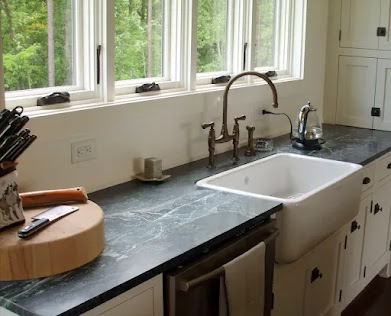
kitchen countertops, then a soapstone countertop is ideal for your space. Soapstone countertops are heat resistant. As such, you do not need to worry about discolourations or damage from heat. This makes
soapstone countertops ideal in most kitchens.
It is an opaque stone of grey colour with a slightly muted lustre. However, it may look a little different depending on the presence of impurities: for example, have a slightly yellowish, reddish or greenish tint, as well as white or brownish inclusions.
The composition of the mineral is not constant, the main components of the rock are talc - from 40 to 50%, magnesite - from 40 to 50%, chlorite - from 5 to 8%. Due to the high content of the latter, as well as quartz impurities, the hardness of steatite is three times greater than that of talc, which increases the strength of its products with it.
Hardness ranges from 1-to 5.5 on the Mohs scale. Soapstone is subject to mechanical damage but is
easily restored by grinding. Other characteristics of the breed include:
- high heat capacity;
- heat resistance;
- the density of the structure;
- low electrical conductivity;
- moisture resistance;
- resistance to acidic solutions.
Only concentrated alkali is able to destroy the surface of the mineral.
mong with therapists, the mineral is in demand because of its unique heat capacity. It is used as a natural heating pad. With its help, diseases of the musculoskeletal system are treated: osteochondrosis, sciatica, radiculitis.
Heated to 50 ° C, steatite retains heat for an hour. A similar effect is characteristic of cooling. The cold mineral is applied to places of bruises, and painful points with inflammation of the joints.
In addition, there is a beneficial effect of soapstone:
- to raise immunity;
- lowering blood pressure;
- the concentration of attention increased perseverance;
- treatment of acute respiratory diseases;
- prevention of rickets.
The mineral is used by people engaged in the occult. It is believed that the pendant with the insert drives away dark forces. Talismans in the form of a ball or animal figurines have great power, giving the ability to clairvoyance, and opening a connection with the cosmos. To interact with the subtle world, amulets with steatite are intended.
Talcochlorite in the design of bathrooms
Suitable heat capacity for a bath or sauna makes talc chlorite a popular material for cladding. Polished or polished tiles from this rock are widely used in the
decoration of walls and floors, in addition, it is often laid out on the walls of pools, as well as decorate sunbeds. In this case, another useful property of grey stone is relevant: the ability to absorb noise well. And, of course, in the interior, it looks very beautiful and stylish.



Comments
Post a Comment